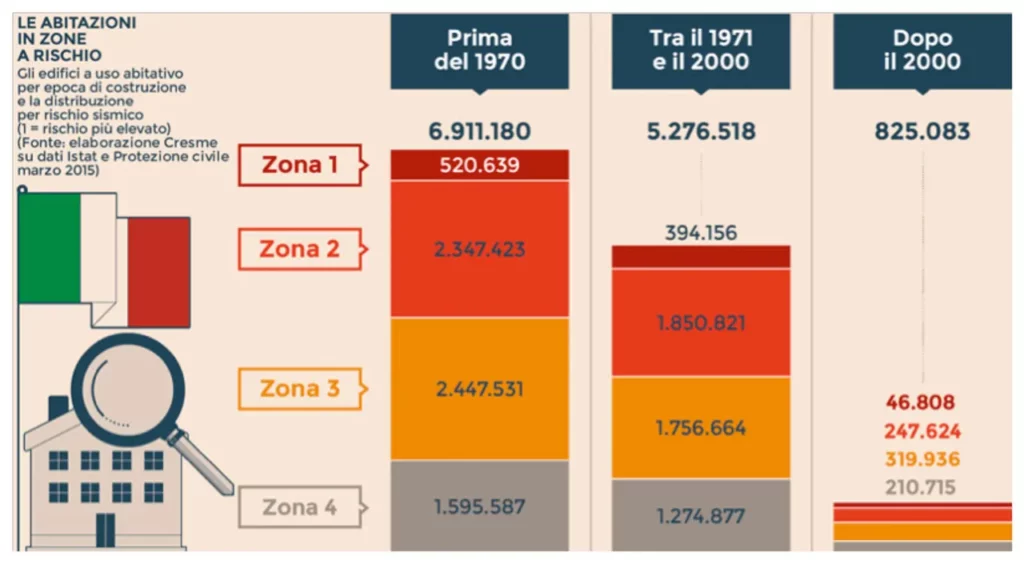

1) Engineering Services for the Assessment of the Seismic Vulnerability of Structures through the determination of the Seismic Risk Indicator.
2) Engineering Services for the Seismic Protection of Structures.
Items 1) and 2) apply to:
– Buildings
– Structures
– Industrial Plants
– Viaducts
– Bridges
– Dams
Constructed in brick and/or stone masonry, reinforced masonry, reinforced concrete, prestressed reinforced concrete, precast reinforced concrete, steel and timber.
Regulations
O.P.C.M. 3274:2003 requires all public and private owners of buildings deemed strategic for civil protection purposes or relevant in relation to the consequences of a potential collapse, and constructed prior to 1984, to carry out a seismic vulnerability assessment of such structures.
The list of strategic and relevant structures is contained in Regional Council Resolution (D.G.R.) No. 3645 of 28 November 2003. Among the buildings classified as relevant are nurseries, schools of all types and levels, stadiums, sports arenas, gyms, health and social care facilities (homes for the elderly and disabled), public buildings subject to overcrowding, commercial premises with a floor area exceeding 5,000 sq m, museums, libraries, post offices, bank premises, conference and entertainment venues with a capacity exceeding 100 persons, industrial facilities employing more than 100 people, churches and places of worship.
E.I.A.
1) Engineering Services for the Environmental Impact Assessment of Companies, for the purpose of preparing the External Emergency Plan (EEP) by the Prefects.
Regulations
Article 21 of Legislative Decree No. 105/2015, entitled “Implementation of Directive 2012/18/EU on the control of major-accident hazards involving dangerous substances”, provides that the Prefect shall prepare the EEP within two years of receiving the necessary information from the operator pursuant to Article 20, paragraph 4. Paragraph 6 of the same Article 21 further requires that the EEP be reviewed, tested and updated at intervals not exceeding three years.
During the implementation phase of the new legislation, it is considered necessary for establishments presenting major-accident hazards of an environmental nature and operating within the provincial territory to carry out a technical review of their environmental risks, identifying the most significant ones and defining the relevant control and monitoring measures.
In particular, it will be useful for each Company to identify the potential impacts of its production processes on environmental receptors – air, water, soil, population, animal and plant species – by assessing potential damage scenarios, including issues arising from the overlap of natural hazards within the same area, such as seismic or flood risk.
This will make it possible to gather all the information required for the preparation of the External Emergency Plan, ensuring greater consistency with the accident scenarios identified in the Safety Report and consequently allowing the EEP to be tailored to the specific characteristics of the establishment, while also assessing interaction aspects and the information provided by the Internal Emergency Plan – IEP.
L’IMMAGINE SOTTOSTANTE QUESTO TESTO NON E’ COMPLETAMENTE VISIBILE NEL SITO, RISULTA TAGLIATA.